
Alpha Lipoic Acid (ALA): Benefits, Dosage and Safety
Alpha lipoic acid is an antioxidant compound your body makes in small amounts and uses in energy production inside mitochondria. As a supplement it is best studied for diabetic peripheral neuropathy, where 600 mg per day may modestly ease symptoms such as burning and tingling. Evidence for weight loss, blood sugar control and healthy ageing is weaker. It is usually well tolerated but can lower blood sugar.
Last reviewed 2026-10-17. Educational information, not medical advice.
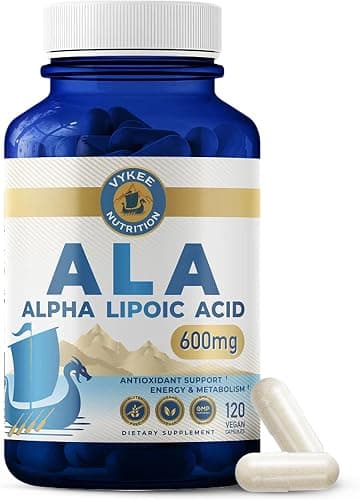
Vykee Nutrition Alpha Lipoic Acid 600mg Capsules
Alpha lipoic acid 600mg capsules — check price on Amazon.
Vykee Nutrition Alpha Lipoic Acid 600mg Capsules
Check price on AmazonWhat is Alpha Lipoic Acid?
Alpha lipoic acid (ALA, also called lipoic acid or thioctic acid) is a sulfur-containing fatty acid. Bound to enzymes, it acts as a cofactor for mitochondrial enzymes that turn food into energy. The body makes enough of it for this job, so it is not an essential nutrient.
Free ALA from supplements behaves differently: it and its reduced form, dihydrolipoic acid, act as antioxidants and may help recycle other antioxidants such as vitamin C and glutathione. Free ALA levels only rise briefly after a dose because it is cleared quickly.
Small amounts occur in organ meats, spinach, broccoli and tomatoes, but food does not provide the amounts used in studies. Supplements contain either racemic ALA (a 50:50 mix of R and S forms) or R-ALA, the natural form.
Typical uses
Diabetic peripheral neuropathy
This is the best-studied use. Trials of intravenous ALA in Germany, and several oral trials at 600 mg per day, found modest improvements in neuropathic symptoms such as pain, burning and numbness over 3–5 weeks. Longer oral trials have mixed results, and ALA does not replace blood sugar control or prescribed treatment.
Blood sugar and insulin sensitivity
Some studies report small improvements in fasting glucose or insulin sensitivity in people with type 2 diabetes. Effects are inconsistent and smaller than those of standard medicines.
Weight management
Meta-analyses suggest ALA may produce a small extra weight loss (around 1 kg on average) compared with placebo over several months. The effect is unlikely to be meaningful on its own.
Other uses
ALA is also marketed for skin ageing, nerve compression symptoms, migraine prevention and multiple sclerosis. These uses are supported only by small or early studies.
How strong is the evidence?
- ModerateSymptoms of diabetic neuropathy. Several RCTs; IV data stronger than oral; benefits modest.
- LimitedBlood sugar control in type 2 diabetes. Small, inconsistent effects.
- LimitedWeight loss. Meta-analyses show a small average effect.
- InsufficientSkin ageing, migraine, MS. Small or preliminary studies.
Typical doses
| Context | Dose | Notes |
|---|---|---|
| Diabetic neuropathy (oral, studied dose) | 600 mg once daily | Higher doses (1,200–1,800 mg) caused more nausea without clear extra benefit. |
| General supplement use | 300–600 mg per day | Common label range. |
| R-ALA products | Often 100–300 mg per day | R-ALA is the natural form; fewer trials than racemic ALA. |
- Take ALA on an empty stomach, about 30 minutes before a meal: food reduces absorption.
- Most clinical trials used racemic ALA, so labels that list "alpha lipoic acid" without specifying R are the form with the most data.
- Benefits on neuropathy symptoms were usually assessed after 3–5 weeks or longer.
Safety, side effects and interactions
Safety
- ALA is generally well tolerated at 300–600 mg per day for several months.
- Common side effects are mild nausea, heartburn, stomach upset and, rarely, skin rash or itching.
- ALA can lower blood sugar. People with diabetes should monitor glucose closely when starting it.
- Very rare cases of insulin autoimmune syndrome (episodes of low blood sugar) have been reported, mainly in people of East Asian ancestry with a specific HLA type.
- People who drink heavily or have thiamine (vitamin B1) deficiency should not take ALA without medical advice.
Interactions
- Diabetes medicines (insulin, sulfonylureas and others): additive blood sugar lowering; doses may need adjustment.
- Thyroid hormone (levothyroxine): animal and limited human data suggest possible interference; separate doses and monitor.
- Chemotherapy: antioxidants may interfere with some regimens; ask your oncologist first.
Who should avoid it or ask a doctor first
- Pregnancy and breastfeeding: not enough safety data.
- Children, unless prescribed.
- People with a history of low blood sugar episodes.
Frequently asked questions
Is R-ALA better than regular alpha lipoic acid?
R-ALA is the natural form and is better absorbed per milligram, but most clinical trials used racemic ALA. There is no clear evidence that R-ALA gives better results in people.
Does ALA help with weight loss?
Studies show at most a small extra loss, about 1 kg on average over several months. It is not an effective weight loss treatment on its own.
How long does ALA take to work for nerve pain?
In trials, improvements in neuropathy symptoms appeared after about 3–5 weeks of 600 mg per day. Some people notice no change.
Is ALA the same as ALA omega-3?
No. The same abbreviation is used for alpha-linolenic acid, a plant omega-3 fat. Alpha lipoic acid is an unrelated antioxidant compound.
Can I take ALA with metformin?
They are often used together, but ALA may add to blood sugar lowering. Talk to your doctor and monitor your glucose.
Choosing a Alpha Lipoic Acid supplement
- Check whether the product is racemic ALA or R-ALA and the milligrams per capsule.
- A 300 mg or 600 mg capsule makes the studied dose easy to reach.
- Choose brands with third-party testing (USP, NSF or an independent lab).